Bridge (Dashboard)
Bridge is the HTML dashboard and the aiohttp server that backs it — the
human-facing surface of TeaParty. It runs on localhost:8081, renders a
small family of static pages, and streams live events from the rest of the
platform over a single WebSocket. Bridge is a reflection and interaction
layer on top of the orchestrator, not an orchestrator in its own right. It
observes state produced by other systems, and it forwards human input back
into them. It does not decide, dispatch, or drive work.
Why it exists
Humans need visibility into running sessions and a place to talk to agents without leaving the surface. Bridge gives them both in one browser tab.
- One place to watch everything. Active sessions, dispatch trees, heartbeat, cost, and artifacts are all rendered from the same state the orchestrator already writes. Operators do not need a terminal open to know what is happening.
- One place to talk. The chat blade is the primary interaction
surface. Every page except
chat.htmlmounts it, so the user can hold a conversation with the office manager, a project lead, or their own proxy without context-switching away from the page they are on. See chat-ux. - One place to edit configuration. Config screens expose the
.teaparty/tree — management team, projects, workgroups, agents, skills, hooks — as browsable, toggleable forms instead of YAML the human has to hand-edit. - One place to intervene. Typing into an active job's chat triggers an INTERVENE event; the Withdraw button emits a kill signal. Bridge is where direct intervention happens, because that is where the human already is.
How it works
Bridge is a thin aiohttp application that serves static HTML and JS from
teaparty/bridge/static/, exposes a REST surface for config CRUD, and
maintains a single WebSocket broadcast channel at /ws.
- State in. A
StateReaderreads session and config state from disk. AStatePollerwatches for CfA state changes, heartbeat updates, and terminal-session transitions, emittingstate_changed,heartbeat, andsession_completedevents. AMessageRelaysubscribes connections to specific conversations on the per-session messagingSqliteMessageBusinstances and deliversmessage,input_requested, andescalation_clearedevents — the fetch-and-subscribe atomicity contract in chat-delivery ensures each connection receives only the events it subscribed for. - State out. Human chat input posts through the relay back into the conversation that the blade is bound to, where the target agent picks it up on its next turn.
- Navigation. Pages are organized as project → session → detail,
with in-place anchor navigation so browser-native gestures
(
Cmd+click, middle-click) keep working. See navigation for the rule and the regression guard that enforces it. - Chat is one codepath. Every page that shows a chat mounts
accordion-chat.js. There is exactly one chat UX implementation; a CI test blocks merges that introduce a second. See chat-ux. - Workspace integration. Artifact pages render files directly out of the session worktree surfaced by workspace; Bridge does not own the worktree, it just reads it.
The server lives in teaparty/bridge/server.py; the state layer lives in
teaparty/bridge/state/; the static UI lives in teaparty/bridge/static/.
Launch it with ./teaparty.sh from the repo root.
Status
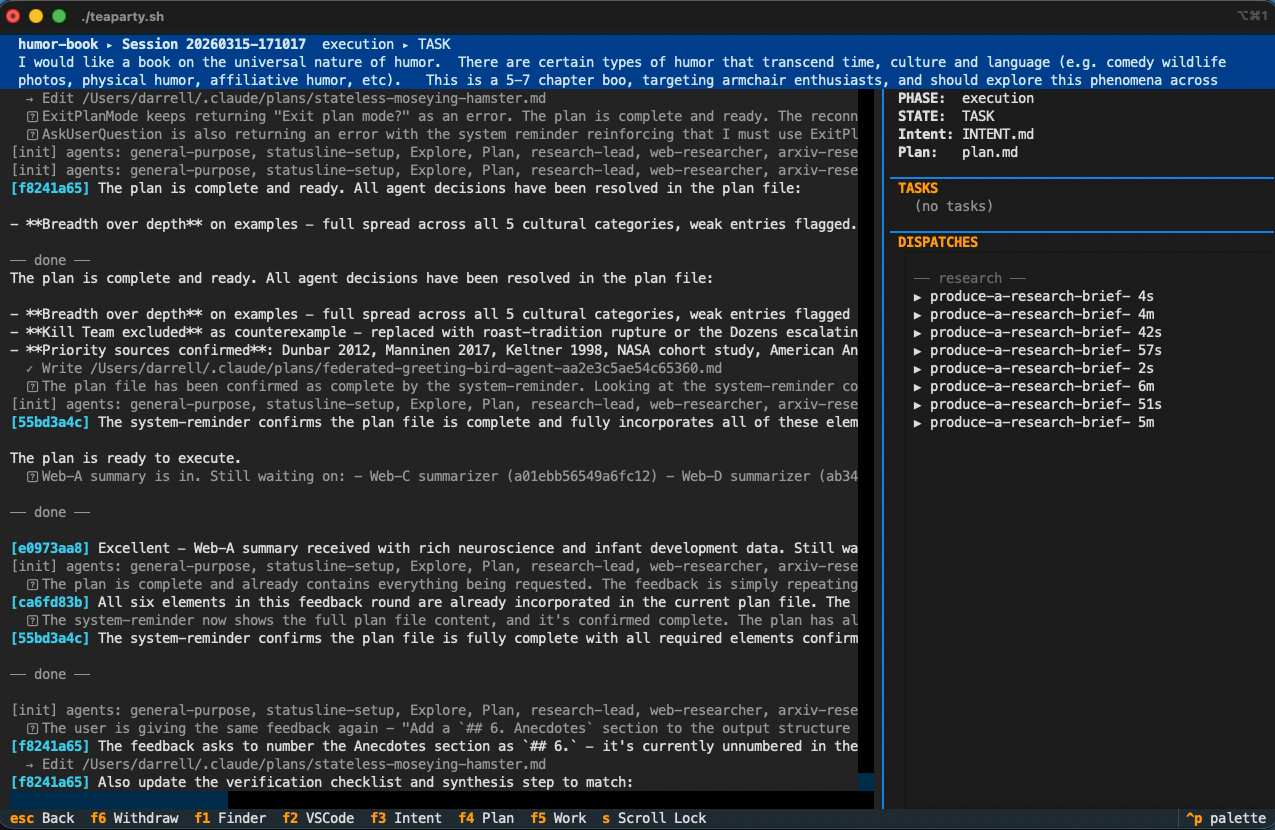
Operational and used daily. The case study in execution includes screenshots of the dashboard during a live run — see the dashboard screenshot for the blade, the dispatch accordion, and the session list in context.
Known rough edges:
- The config screens render the full catalog for every page load; for
large
.teaparty/trees this is noticeable but not blocking. - Heartbeat, stats, and telemetry each have their own emitter; the three have not yet been consolidated onto a shared event schema.
- A dedicated reference page for the Bridge REST surface was forthcoming in the legacy design layout and is still owed.
Deeper topics
- navigation — in-place anchor navigation, browser-native gestures, the regression guard.
- chat-ux — the accordion chat blade, the one-codepath rule, the page routing table.
- artifact-page — the artifact viewer and pinning model.
- heartbeat — three-state liveness indicator.
- stats-bar — cost and token display.
- telemetry — what Bridge emits and how it is consumed.