End-to-End Walkthrough
Live session
Project humor-book, session 20260315-171017, March 15–16, 2026.
A single natural-language prompt — four sentences about humor, universality, and armchair enthusiasts — entered the TeaParty orchestrator and emerged as a ~55,000-word manuscript: a prologue, seven chapters, two independent editorial reports, two verification reports, and five title alternatives.
I would like a book on the universal nature of humor. There are certain types of humor that transcend time, culture and language (e.g. comedy wildlife photos, physical humor, affiliative humor, etc). This is a 5-7 chapter book, targeting armchair enthusiasts, and should explore this phenomena across cultural, temporal, language, belief, and technological boundaries. Thesis: Humor is what unites us.
The system executed the full CfA lifecycle: intent capture (2 questions, 5 minutes), planning (4 questions, 16 minutes), and five execution phases — research, specification, production, editorial, and verification — with the human proxy handling assert gates below the top level.
Scope of What This Session Demonstrates
This case study is the strongest end-to-end demonstration we have today, but the four research pillars are not all demonstrated here to the same standard. Where the evidence lands:
- CfA Orchestration — cleanly demonstrated. The state machine drove the session through Intent → Planning → Execution with real artifact production at each phase. The state machine trace below is the ground-truth record.
- Human Proxy — cleanly demonstrated. The proxy participated at approval gates, produced substantive revision notes at
TASK_ASSERT, and generated the interaction log preserved inartifacts/proxy-interactions.jsonl. The proxy-confidence model evolved over the session. - Learning & Memory — partially demonstrated. Post-session extraction produced the observations discussed in Learnings. Single-session scope; no cross-session retrieval or promotion was exercised.
- Hierarchical Teams — not cleanly demonstrated by this session. Execution did produce research briefs, specs, drafts, editorial reports, and verification reports across five phases — those artifacts exist in
artifacts/and are real. But the substantive work for each phase was driven primarily by the project lead rather than by independent sub-agents running their own CfA cycles in isolated worktrees. The orchestration dispatched work, but not in the clean three-tier OM → project-lead → workgroup-agent pattern the Hierarchical Teams pillar describes. Recursive multi-tier dispatch is the subject of the recursive-dispatch proposal and remains on the list for a future case study.
Treat this session as evidence for CfA + Proxy + single-session Learning, not as the end-to-end hierarchical-dispatch demonstration. The manuscript is real; the protocol is real; the gaps in the hierarchical story are honest and tracked.
User Experience
The entire interaction — from the initial prompt through intent capture, planning, and all five execution phases — occurred within the TeaParty interactive console. The human typed the four-sentence prompt, answered six questions across two brief dialogs, and then watched.
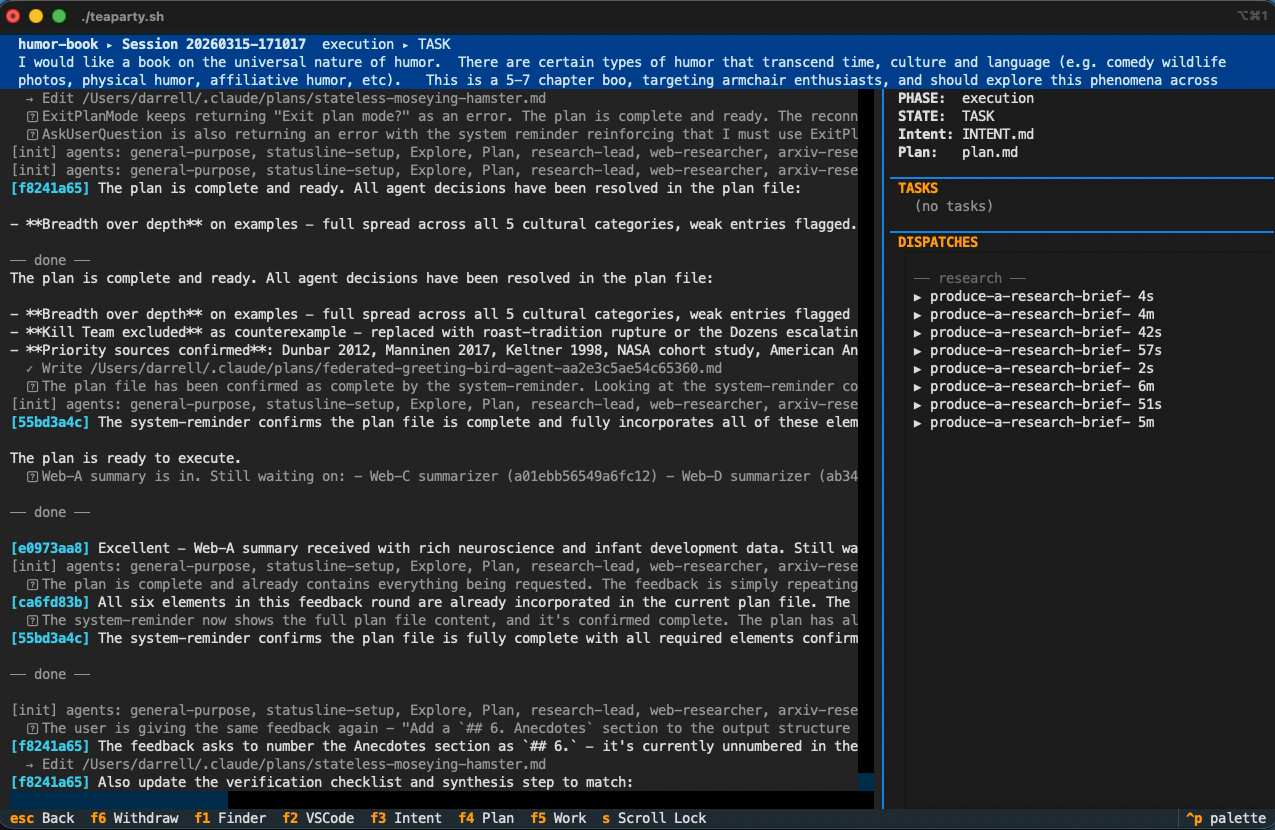
This is the bridge dashboard during the research phase. The session panel shows the original prompt and the CfA state history — each transition from IDEA through PLAN visible as it happened. The activity stream shows the project lead's execution in real time: phase transitions, worktree creation for dispatched tasks, proxy approvals at assert gates, deliverables landing on disk.
From the human's side, the experience after the initial dialog was: watch the stream and review artifacts as they arrived. The console didn't just show progress — it provided direct links to the generated artifacts in their worktrees, making it easy to open a research brief, read a chapter draft, or inspect an editorial report without hunting through the file system. At approval gates, the human could click through to the relevant artifacts, review them, and approve or correct — all without leaving the console.
There was no context-switching between tools, no manual file management, no copy-paste between agents. The orchestrator handled phase transitions, worktree creation, artifact routing, and quality gates autonomously. The human's role reduced to the six consequential decisions at the start and a handful of gate approvals at the end.
The Story in Five Parts
Intent & Planning — Two agents, six questions, 21 minutes. The dialog transcripts show how a four-sentence prompt became a complete intent document and a five-phase execution plan — with the agents bringing proposals, not open-ended questions.
Execution — Five phases (research, specification, production, editorial, verification) producing eight research briefs, eight specs, eight drafts, two editorial reports, and two verification reports. How the project lead sequenced the phases and handled the task-assert revision loop. See the page for an honest account of where dispatch was genuinely hierarchical vs. where the lead carried the work.
The Manuscript — What the session actually produced: a complete popular non-fiction book with links to every chapter draft, from initial to final.
Obstacles — Watchdog timeouts, token limits, rate-limit collisions, a prologue that refused to persist, and agents that couldn't figure out where they were in the worktree hierarchy. What went wrong and how the system adapted.
Learnings — The learning system's self-assessment: alignment observations, the proxy confidence model, and the "frustration misinterpretation" where the proxy read timeouts as human annoyance.
Key Takeaways — What the session demonstrates about the four pillars, where the opportunities lie, and the overall assessment.
By the Numbers
| Metric | Value |
|---|---|
| Prompt length | 4 sentences |
| Human dialog turns | 6 (intent) + 4 (planning) + ~6 gate approvals |
| Phases executed | 5 (Research → Spec → Production → Editorial → Verification) |
| Artifacts produced per phase | 8 briefs / 8 specs / 8 drafts / 2 editorial / 2 verification |
| Total artifacts produced | 8 briefs, 8 specs, 8 drafts, 2 editorial reports, 2 verification reports, 5 title alternatives |
| Total manuscript length | ~55,000 words |
| Session restarts required | Multiple (watchdog timeouts + token limits) |
CfA State Machine Trace
| Time (UTC) | State | Action | Actor |
|---|---|---|---|
| 00:10:17 | IDEA | propose | human |
| 00:14:56 | PROPOSAL | assert | intent_team |
| 00:15:54 | INTENT_ASSERT | approve | proxy |
| 00:15:59 | INTENT | plan | planning_team |
| 00:29:27 | DRAFT | assert | planning_team |
| 00:31:51 | PLAN_ASSERT | approve | proxy |
| 00:31:51 | PLAN | delegate | project_lead |
| 00:32–05:35 | TASK | execute | project_lead (5 phases) |
| 05:35:21 | TASK_ASSERT | correct | proxy (3 revision notes) |
| 05:40–05:56 | TASK_ASSERT | correct ×6 | proxy (confirmation loop) |
| 05:56:10 | TASK_ASSERT | approve | proxy |
| 13:16:34 | WORK_ASSERT | approve | proxy |